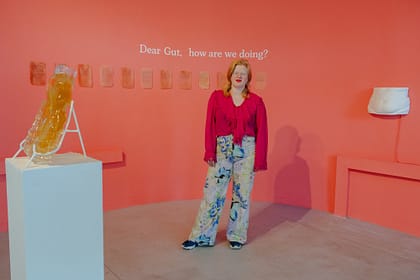
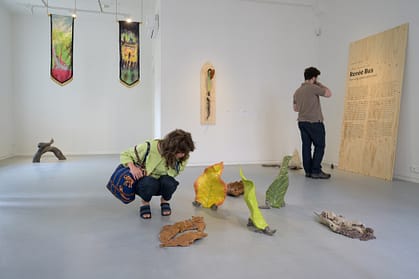
Ecology Futures
Not a singular future, but a plural one. Not an individual being disconnected from others, but rather an assemblage of many entities. Living, decaying, human, other-than-human, connections forming and re-forming as circumstances warrant. The pathway teaches you bio-art and –design methodologies, critical theory and technology-based perspectives for eco-oriented research projects.
Program
The Master track Ecology Futures offers a practice-led research masters programme where you will:
—Work with living materials
—Think and work ecologically
—Immerse yourself within vibrant ecologies
—Learn how to create with the beings of the world
—Develop new futures
The program explores innovative approaches to environmental issues through bioart and biodesign, examining current ecological challenges and potential futures. It emphasizes that multiple futures are possible by recognizing the interconnected relationships among humans, more-than-humans, and the environment, all of which are influenced by various factors. The program integrates multiple disciplines, offering hands-on lab work with living materials, theoretical studies, fieldwork, and both traditional and digital tools to realize ideas. Participants will develop skills to address complex problems across diverse fields, including environmental challenges. Additionally, the program provides access to the Material Incubator Lab at CARADT, enabling students to build practical, creative, and artistic research skills through hands-on experience.
Ecology Futures prepares you to address difficult problems not only related to ecology but any domain that requires the input of multiple skillsets. You will have access to the Material Incubator Lab of the Centre of Applied Research for Art, Design, and Technology (CARADT). This is a unique feature of our program where you develop laboratory skills that support your practice-led artistic research. Further workshop facilities provide students instruction on 3D visualisation, VR/AR, non-linear immersive and iterative storytelling, spatial design, interactive media, and access to film & photography, print, wood, ceramics and metal workshops.
Year 1
The first year is thought of as foundational and invites each participant to experiment, explore new possibilities within their own practice and take advantage of the different elective modules offered to them. Informed by research seminars, interdisciplinary modules, and field trips, you will be challenged to redefine your art practice within a collaborative, peer-to-peer environment.
A core component of the first year is the Rethinking the Artist Economy Residency. In this program, all Master in Fine Art and Design students explore how to make their practice both socially engaged and ecologically grounded. By providing the tools to move beyond extractive systems, we help you transition toward ways of working rooted in care, reciprocity, and connection. Ultimately, the residency supports you in building a sustainable livelihood based on what you value and find meaningful.
Year 2
The second year is focused on thesis writing and a final graduation project. This year, the participant can delve in a specific project connecting research and practice.
The third semester features a group exhibition at an external location, and the fourth semester culminates in the graduation show. Here, you will present your graduating work and research to a relevant professional network.
Furthermore, professional practice modules prepare you to enter the professional field and establish your career after completing the Master’s program. You will be trained in writing funding applications, developing a professional portfolio, and building a comprehensive CV
Program Overview: Master of Arts in Fine Art & Design
- Pathways: Ecology Futures
- Duration: 24 months (4 semesters)
- Mode: Full-time
- Credits: 120 ECTS
- Degree: Master of Fine Art and Design
- Institution: Avans University of Applied Sciences
- Accreditation: Fully accredited by NVAO